The classical ideal
“I can guarantee that it is more meritorious to create beauty in 1947 than under the paternal tutelage of a Perugino.”
SALVADOR DALÍ
New Paintings by Salvador Dalí, Bignou Gallery, New York, 1947
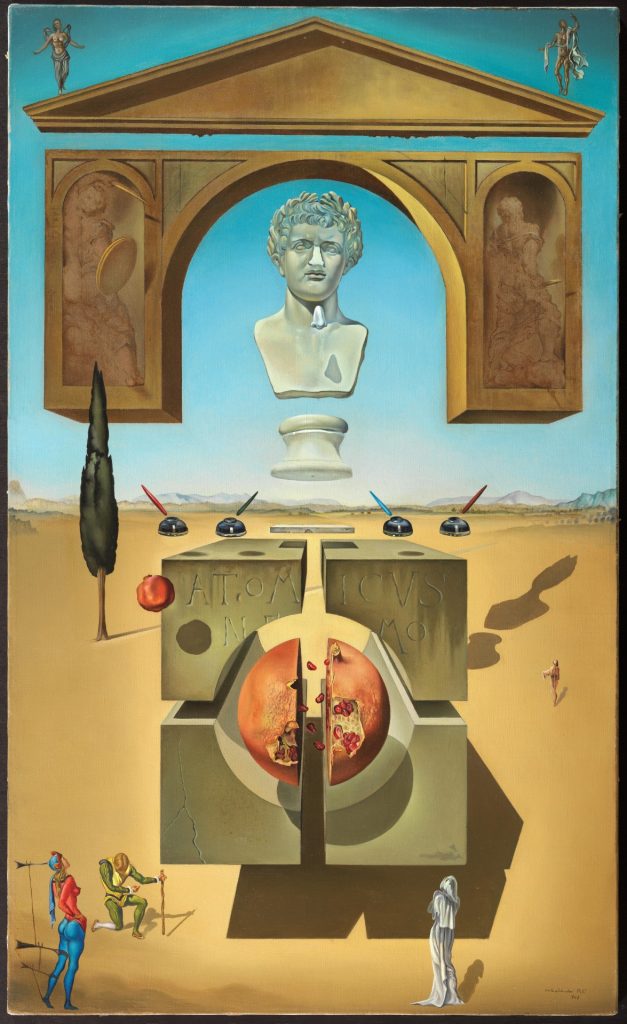
Dematerialization Near the Nose of Nero
1947
Oil on canvas
Fundació Gala-Salvador Dalí
Num. cat. P 626
Dematerialization Near the Nose of Nero
The championing of classicism and the Renaissance, which is strongly rooted in Salvador Dalí’s work during the 1940s, stemmed from a deep yearning to reunite with the old continent, the longed-for Europe, to which he had not returned since going into exile in the United States in 1940. In works such as Dematerialization Near the Nose of Nero, from 1947, this classical ideal of beauty continues to be valid, but acquires a new drift following the dropping of the first atomic bomb on Hiroshima, an event that marks a before and after in the history of humanity and made a profound impression on the artist. He recalled it years later in his book Unspeakable Confessions (1973): ‘The atomic explosion of August 6, 1945, shook me seismically. Thenceforth, the atom was my favorite food for thought. Many of the landscapes painted in this period express the great fear inspired in me by the announcement of that explosion. I applied my paranoiac-critical method to exploring the world.’
Unlike works such as Melancholy Atomic and Uranic Idyll (Cat. No. P 606), which Dalí painted in 1945 while still in a state of shock and which, as a result, is far darker and more apocalyptic in tone, the painting we have here may surprise us with its serene and harmonious appearance. Dalí’s interest in quantum physics and the splitting of the atom is manifested in his painting through the dematerialisation of figures and objects, which often appear suspended and fragmented. In this scene, four isolated characters who seem to be from other eras contemplate, motionless, the weightlessness of the various elements, bearing witness to the birth of a new scientific reality and its impact on Dali’s creation, which inaugurates its own atomic stage.
Elements such as the bust of Nero and the iconographic motif of the pomegranate deserve special attention. On the one hand, the emperor, whom we associate with the destruction and burning of Rome, a symbol of devastating, arbitrary power, can be read here as an allusion to humanity’s capacity for self-destruction, amplified with the arrival of the nuclear age. On the other hand, the pomegranate, a fruit linked since antiquity to death and resurrection, introduces an ambivalent symbolic dimension: while it can evoke the bursting and dispersion of the fruit, it also suggests an implicit rebirth through the dissemination of its seeds. The artist thus gives form to a reflection on destruction and transcendence, and envelops it with classicism, “the eternal source of ancient beauty”, as a way to render the fear and uncertainty of his time more bearable.